
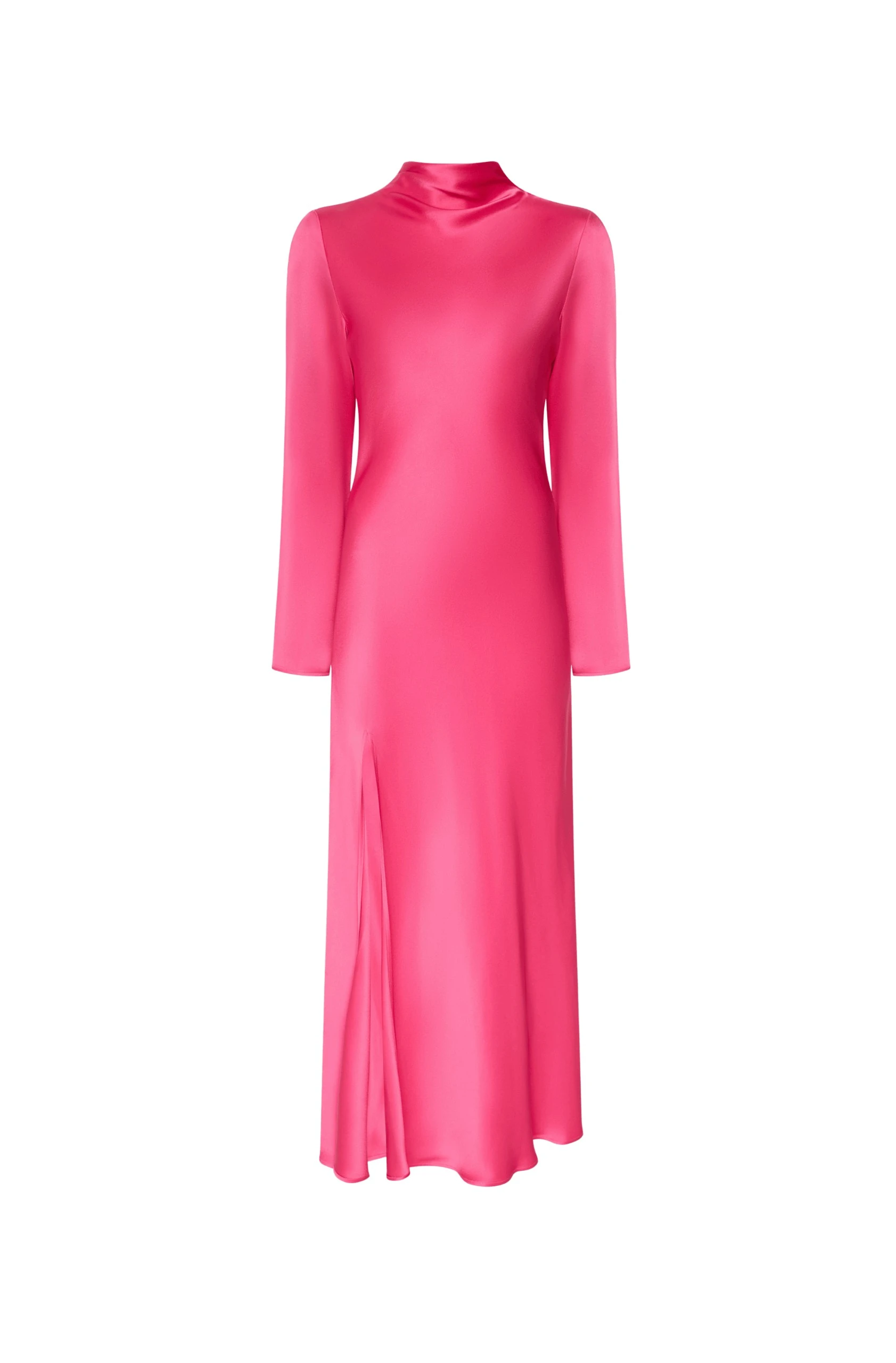


If LaPointe has a house fabric it is doubleface satin. It runs through the dresses, the trousers, the cape tees and the blazers, and it is the reason the collection photographs the way it does. Learning how this one cloth behaves tells you most of what you need to know about buying the brand.
What is doubleface satin?
Satin is a weave, not a fibre. It floats long threads across the surface of the cloth, which is what produces the shine. Doubleface means the weave is built so both sides are finished, which gives the fabric more body than a single-face satin of the same weight.
The practical difference is drape. A thin satin floats and clings. A doubleface satin falls. It holds a column shape, it does not show every line underneath it, and it takes a deep colour without going flat. LaPointe cuts it mostly in acetate and viscose blends, sometimes with a little elastane.
Why does LaPointe use satin for so much?
Because it does two jobs at once. It reads as evening, and it is comfortable enough to sit down in for three hours.
It also carries colour better than almost anything else at the price. A berry, an emerald and a mulberry all look saturated in satin and muddy in a matte crepe. Since the house is built on strong colour, the fabric choice follows from the design.
Which LaPointe satin piece should I start with?
The cape tee. A wide, short-sleeved satin top that skims rather than fits. It is the most worn piece in the collection for a reason: it goes with a jean, a tailored trouser and its own matching satin pant. Find it in tops.
The relaxed pleated trouser. Full through the leg, pleated at the natural waist, long enough for a heel. It is the other half of the tonal column. See pants.
The bias slip and halter gowns. The evening end. Cut on the diagonal grain so the satin follows the body without seams. Browse dresses.
The shift dress. Short, wide-sleeved, often with a feather cuff. The easiest satin dress to wear in daylight.
Does satin show every lump?
A cheap satin does. A doubleface one does much less, because the weight of the cloth carries it away from the body rather than over it.
Two things help further. Cut matters more than fabric: a bias gown skims, a straight-cut column can pull. And colour matters: a mid to deep shade shows far less than a pale one under a flash. If you are worried, start with chocolate, marine and mulberry rather than cloud and oat.
How do you look after satin?
Dry clean it, hang it on a padded hanger, and never fold it for storage. Satin takes a crease along a fold line and that crease is difficult to remove.
For travel creases, hang the piece in a bathroom with a hot shower running rather than pressing it. A direct iron on acetate satin can leave a permanent shine mark, and a steamer held too close will do the same. If you must press, use a low heat and a pressing cloth on the reverse.
Deodorant and perfume are the other enemies. Put both on before the garment, and let them dry.
What sizes does the satin come in?
LaPointe sizes on the US ladder and Coveti converts to UK, so a UK 10 is a US 4 at source. Most of the satin is cut true to size. The bias gowns relax slightly as you wear them, so take your usual size rather than sizing down. Full detail in the sizing guide.
Where to buy
Coveti carries the LaPointe satin collection across dresses, tops, trousers and tailoring. Browse the LaPointe edit, and see the satin suit guide for the tailored end. Every piece is authenticated before dispatch.
Frequently asked questions
What is doubleface satin?
Satin is a weave that floats long threads across the surface to create shine. Doubleface means both sides are finished, which gives the cloth more body. It falls rather than clings, holds a column shape and takes deep colour well.
Is LaPointe satin see-through?
No. The doubleface weight carries the cloth away from the body rather than over it, so it is far less revealing than a thin single-face satin. Mid and deep shades show less under a camera flash than pale ones.
Can you iron LaPointe satin?
Avoid it. A direct iron on acetate satin can leave a permanent shine mark. Hang the piece in a bathroom with a hot shower running to drop a crease. If you must press, use low heat and a pressing cloth on the reverse.
What is the most versatile LaPointe satin piece?
The satin cape tee. It is wide and short-sleeved, and it works over denim, with a tailored trouser and with its own matching satin pant.
Should I size down in LaPointe satin?
No. Most of the satin is cut true to size, and the bias gowns relax slightly as you wear them, so take your usual size.
Read next
Written by Gemma Deeks, Fashion Editor at Coveti.

Related Posts
Yves Salomon Fur Hats, Earmuffs and Headbands: The Accessories Guide
Yves Salomon makes fur hats for women in fox and mink, from the trapper-style chapka to a mink bucket hat, plus fur earmuffs, headbands, scarves, snood-style hoods and mittens. At Coveti the new Yves Salomon accessories start at $340 for rex rabbit earmuffs and reach $5,960 for a long mink...
Yves Salomon vs Moncler vs Mackage: Which Luxury Winter Coat to Buy
Yves Salomon, Moncler and Mackage all make luxury winter coats, but they start in different places. Yves Salomon is a Paris fur house that adds fur, shearling and Loro Piana fabrics to its down jackets and parkas. Moncler is the down specialist known for the quilted puffer. Mackage is a Montreal...
Apres-Ski Outfits: Five Yves Salomon Looks for the Chalet and Town
A good apres ski outfit is warm first and polished second: a down jacket, a soft knit, comfortable trousers, a fur hat and boots that grip on ice. Yves Salomon, the Paris fur house, makes every one of those layers. Below are five apres-ski outfits built from its new down jackets, fox ushankas,...
Yves Salomon Puffer and Down Jackets: The Doudoune Edit
Yves Salomon down jackets, which the Paris house calls doudounes, are filled mostly with 95% duck down and 5% duck feathers. They come in three shells: weatherproof technical fabric, Loro Piana wool and silk flannel with a waterproof membrane, and Loro Piana cashmere with a Storm System...
The Yves Salomon Army Parka Guide: Fur Trims, Linings and Length
The Yves Salomon Army parka is the Paris fur house's city version of the military parka, a line the brand says it launched in 2005 by reworking vintage parkas. Today's Army styles pair a waterproof cotton blend shell with a detachable fox fur hood trim and a removable sheared rabbit lining with...
Leather Trousers and Skirts in Winter: The Yves Salomon Way
Leather trousers for women work in winter when the leather is fine and the cut has room. Yves Salomon makes its leather trousers and skirts in lambskin, from tailored straight legs at $2,470 to pleated midi skirts at $4,630, with wide, balloon, cargo and culotte shapes in between. Wear them with...
How to Care for Fur and Shearling: Storage, Cleaning and Cold Storage
To store a fur coat, hang it on a broad, shaped hanger inside a breathable cotton cover, keep it somewhere cool, dark and dry, and send it to professional cold storage over summer. Never seal it in plastic. Yves Salomon care labels on fur and shearling say do not wash and do not dry clean, so...
Yves Salomon Shearling Coats: Toscana, Merino, Lacon and Reversible
Yves Salomon shearling coats are cut from named lambskins, mainly Toscana, Merino and Lacon, and many are reversible, so you wear the suede face one day and the woolly face the next. Toscana is the long, plush fleece; Merino is shorter and silkier; Lacon is soft and glossy. At Coveti, Yves...
Yves Salomon Mink and Fur Coats: Mink, Fox and Rabbit Explained
Yves Salomon is a Paris fur house, and its fur coats are mostly long-haired mink: short jackets at 55 cm, belted coats at 85 cm and maxi coats at 130 cm. Fox goes into collars and knitted jackets, and rex rabbit into trims and accessories. At Coveti, full Yves Salomon mink coats run from $27,730...
Is Yves Salomon Worth It? Prices, Quality and the Yves Salomon Sale
Yves Salomon is worth it if you want outerwear made by a family of furriers that has worked in fur since before 1920. Prices on Coveti run from $340 for rex rabbit earmuffs to $38,050 for a long-haired mink maxi coat. Most shoppers land in the middle: down jackets from $1,770 and shearling...
Yves Salomon Size Guide: How Coats, Parkas and Shearling Fit
Yves Salomon is a French house, so its clothing is cut to French sizes: FR 36 is a UK 8, a US 4 and an IT 40. Add 4 to the French size for Italian and subtract 28 for UK. On Coveti, every Yves Salomon piece is listed in UK sizes, already converted. Fit varies by cut, so read each product's...
Does Yves Salomon Use Real Fur? Furmark, Sourcing and Fur-Free Line
Yes. Yves Salomon uses real fur, including mink, fox and rabbit, and has done since the family began trading furs before 1920. The house says its furs come from farms selected for animal welfare and environmental standards, offers Furmark-certified traceable pieces and signed the Resource Pact...